Three phase inverter have widely use in factory,hospital,airport,kinds of building.They supply 380V,400V,415V stable and good quality pure sine wave electricity to lift,water pump,motor etc.The operation for three phase inverter will more complicated than single phase inverter.Today,as professional three phase inverter manufacturer,we introduce how to operated three phase inverter correctly?
These steps to turn on stand-alone three phase inverter:
This clause applies only to one three phase inverter running alone in a system.(Three phase Inverters running in parallel are not applicable to this startup procedure). When all three phase inverter connections are completed, turn on the three phase inverter according to the following procedure:
1. Please check each battery banks voltage are matched with the DC voltage of the three phase solar inverter label.Turn on the battery switch, the screen of the three phase solar inverter lights up.When three phase solar inverter start to work normally,turn off the battery switch.The test is to check whether the positive and negative batteries are connected correctly.
2. After confirming that the battery is connected correctly and the three phase solar inverter screen light goes out.In this step,battery switch is off.Check the city power input voltage is normally in each phase, turn on the rectifier input switch and then turn on the bypass switch. Select the mains priority in the screen and let the rectifier turn on. If the rectifier input switch is turned on and the three phase solar inverter screen does not display, and the buzzer keeps beeping, it mean the rectifier is not turned on, indicating that the phase sequence of the input lines is wrong. At this time, the rectifier input switch and the main input power should be disconnected, and the each line rectifier input should be checked carefully, connect the (R, S, T) input lines,make them match each phase sequence,turn on the main input power supply and rectifier input switch, if the LCD screen have lit.It mean the input phase sequence are correct.
3. If the rectifier is turned on normally,the need to check the battery positive and negative are correctly or not.Before turn on the battery switch,please check whether the positive and negative terminals of the battery input line are connected to the corresponding terminal.Use multimeter to measure whether the battery positive and negative terminals are connected correctly; turn on the battery switch after confirming that there is no error.
4. Turn on the output switch.The three phase solar inverter will start to work normally.
After best three phase solar inverter start to work normally, turn on the appliance,please pay attention the best three phase solar inverter power capacity.don’t let the best three phase inverter overload.
Warning: When the best three phase solar inverter is working normally, it is strictly forbidden to turn on the maintenance switch, otherwise the best three phase solar inverter will be damaged.Without our engineer’s approval,the maintenance switch is not allowed to turn on.
(2) stand-alone best three phase solar inverter shut down steps
1. First, disconnect the output load switch of the three phase inverter.
2. Turn off the bypass input switch of the three phase inverter.
3. Disconnect the battery switch of the three phase inverter.
4. Disconnect the rectifier input switch of the three phase solar inverter.
5. Turn off the main input power switch.
-
 30kW Solar System Philippines: Cost, Output & Monthly Savings (2026)30kW solar system for Philippine cafes and restaurants with 60kWh battery storage. Cost ~$13,000 (±10%), saves ₱69,000+/month at ₱14.5/kWh, payback in 11 months. Based on real Metro Manila project data.
Do you like ?0
Read more -
 60kW Solar System Philippines: Cost, Output & Monthly Savings (2026)60kW solar system for Philippine resorts and hotels with 120kWh battery storage. Cost ~$25,500 (±10%), saves ₱139,000+/month at ₱14.5/kWh, payback in 16months. Based on real Cebu beachfront resort project data.
Do you like ?0
Read more -
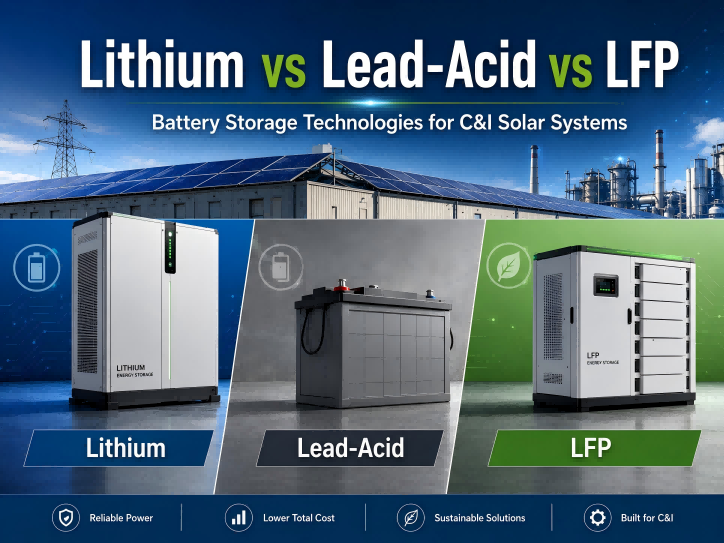 Lithium vs Lead-Acid vs LFP | Battery Storage Technologies for C&I Solar SystemsCompare LFP, NMC, and lead-acid batteries across 12 performance dimensions and 20-year TCO. For daily-cycling C&I solar systems in 2026, LFP delivers 4,000–6,000 cycles, the lowest cost per kWh delivered, and the safest chemistry — making it the only rati
Do you like ?0
Read more -
 Complete Solar Power System Buyer’s Guide for Commercial & Industrial FacilitieA step-by-step buyer's guide for commercial and industrial decision-makers evaluating solar power systems (20kW-1MW). Covers 8-step decision framework: objective definition, load analysis, site assessment, system configuration, battery sizing, ROI calcula
Do you like ?0
Read more -
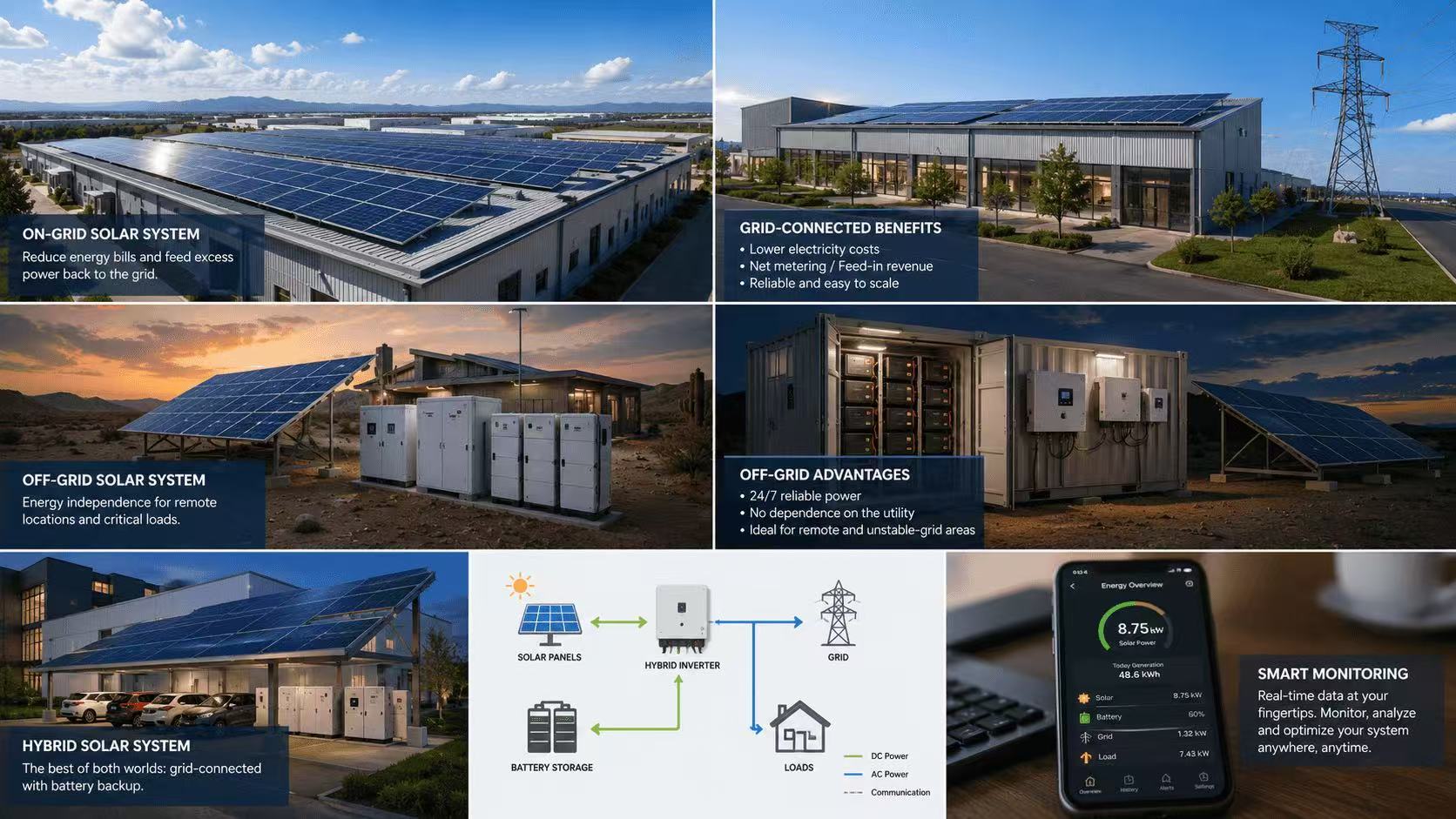 On-Grid vs Off-Grid Solar Power Systems: A B2B Decision Guide for 2026This guide compares on-grid vs off-grid solar power systems for commercial and industrial buyers. Includes detailed cost breakdowns, ROI analysis, and region-specific recommendations for markets like Nigeria, Kenya, Philippines, and Sudan.
Do you like ?0
Read more -
 Solar Power in the Philippines: 2026 Wholesale Import GuideA 2026 B2B procurement guide for solar distributors and EPC contractors entering the Philippine market. Covers net metering policy, product selection, factory pricing, and step-by-step import workflow from China to Manila. Built for wholesale buyers sourc
Do you like ?0
Read more