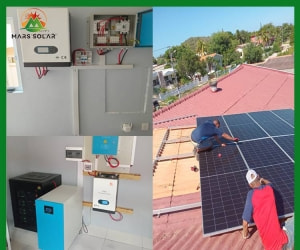
Solar PV System Expansion: Compatibility, Efficiency & Implementation Guide
1. Background and Necessity
Early-installed PV systems generally fail to meet the growing energy demands of modern households and enterprises. Compared with replacing the entire system, expansion is a more economical option—but the core question remains: Can new and old PV technologies work synergistically? This guide, integrating the latest technical solutions, details the simplified path for system expansion, methods to improve compatibility, and economic benefits.
2. Core Drivers for PV System Expansion
The global demand for PV system expansion is growing rapidly, mainly driven by four core factors:
- Sustained electricity price hikes: Taking California (USA) as an example, residential grid electricity prices rose by 12% year-on-year in 2024, while the levelized cost of electricity (LCOE) for PV power has dropped to 0.03-0.05 USD/kWh, making its long-term economic efficiency significantly superior to grid power supply.
- Strong policy support: Many countries have extended subsidy policies (e.g., China has extended household PV subsidies until 2025; the EU's "Green Deal" has increased expansion subsidy intensity by 20%), reducing expansion costs.
- New energy demands: The popularization of electric vehicle (EV) charging piles and home energy storage systems requires a 30%-50% increase in PV system capacity.
- Technological breakthroughs: The widespread adoption of high-efficiency panels (e.g., N-type TOPCon) and smart inverters has greatly reduced compatibility difficulties between new and old equipment.
According to data from the Global Solar Council (2024), the global newly installed PV capacity in 2024 increased by 33% year-on-year to 197 GWdc, of which 62% came from the expansion o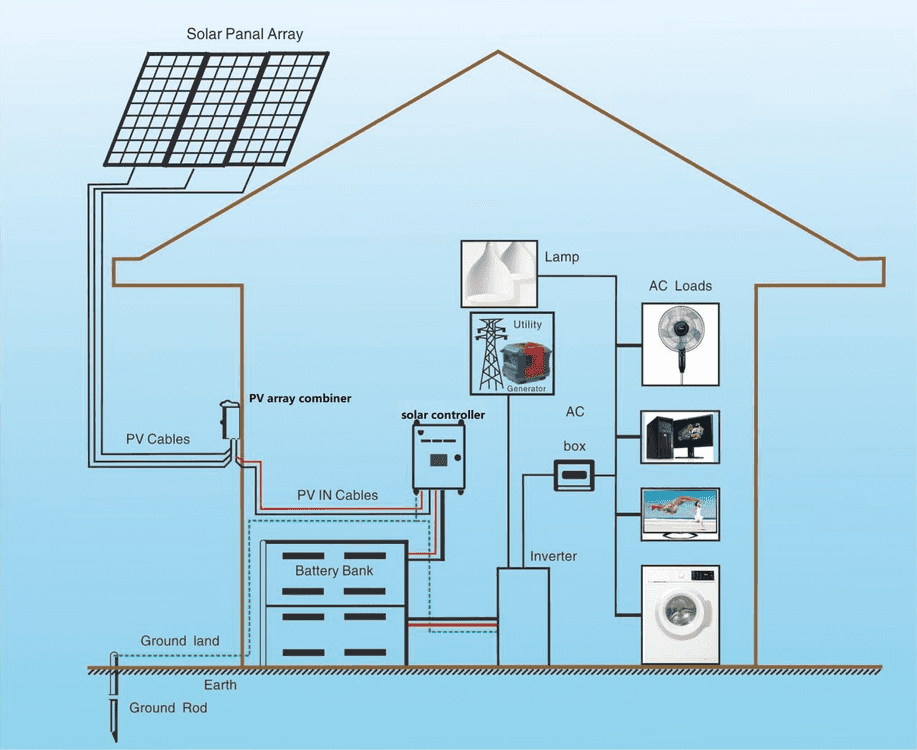 f existing systems (rather than new projects). Users tend to maximize the return on initial investment.
3. Common Expansion Barriers and Solutions (Optimized Version)
|
Core Barriers |
Specific Problem Description |
Practical Solutions |
|
PV Panel Mismatch |
Efficiency loss of the entire system caused by power/voltage differences between new and old panels |
Install string optimizers (e.g., SolarEdge) or microinverters to dynamically balance the voltage/current of each panel, reducing losses to less than 5% |
|
Inadequate Inverter Capacity |
The original inverter cannot handle the input power of newly added panels |
Upgrade to hybrid or multi-MPPT (Maximum Power Point Tracking) inverters, supporting the connection of 3-4 strings of panels with different specifications |
|
Outdated Communication Protocols |
The old system monitoring platform cannot be compatible with data from new equipment |
Deploy a unified monitoring gateway (e.g., Mars Smart Gateway) that supports multi-protocol conversion such as Modbus and WiFi |
|
Incompatible Wiring/Connectors |
The old system uses non-standard interfaces (e.g., T4) |
Uniformly replace with MC4 standard connectors, or have a professional team perform rewiring to ensure IP67 waterproof rating |
4. Market Trends: PV Growth and Expansion Opportunities (Data-Completed Version)
|
Year |
Newly Installed Capacity (GWdc) |
Cumulative Installed Capacity (GWdc) |
Expansion Share (of New Installations) |
Data Source |
|
2021 |
~400 |
1840 (estimated) |
45% (estimated) |
Global Solar Council |
|
2022 |
+228 |
~630 (regional statistics) |
51% |
IEA Renewable Energy Report |
|
2023 |
+446 |
2350 (estimated) |
58% |
BloombergNEF |
|
2024 |
~197 (33% year-on-year growth) |
~597 (regional statistics) |
62% |
Global Solar Council 2024 Annual Report |
2025-2027 Forecast: The demand for expansion will maintain an annual growth rate of 28%. The core driver will be integrated "PV + energy storage" expansion (accounting for over 70%). Avoiding full-system replacement can reduce costs by 40%-60%.
5. Technical Compatibility Solutions (Principle-Detailed Version)
(1) String/Microinverter Systems
- Application Scenario: Mixed installation of new and old panels (e.g., old polycrystalline 270W + new N-type TOPCon 450W)
- Working Principle: String optimizers are connected in series between each panel and the inverter to adjust the output of a single panel in real time; microinverters are directly integrated on the back of panels, realizing "one inverter per panel" and completely eliminating inter-string losses.
- Energy Efficiency Improvement: Can increase the overall efficiency of hybrid arrays by 12%-18%, which is better than the traditional series connection scheme.
(2) Hybrid Inverter Transformation
- Core Advantages: Supports three-port access of "PV + energy storage + grid". The multi-MPPT (2-6 channels) design is compatible with strings of panels with different powers (e.g., 1 string of old 280W panels + 2 strings of new 450W panels).
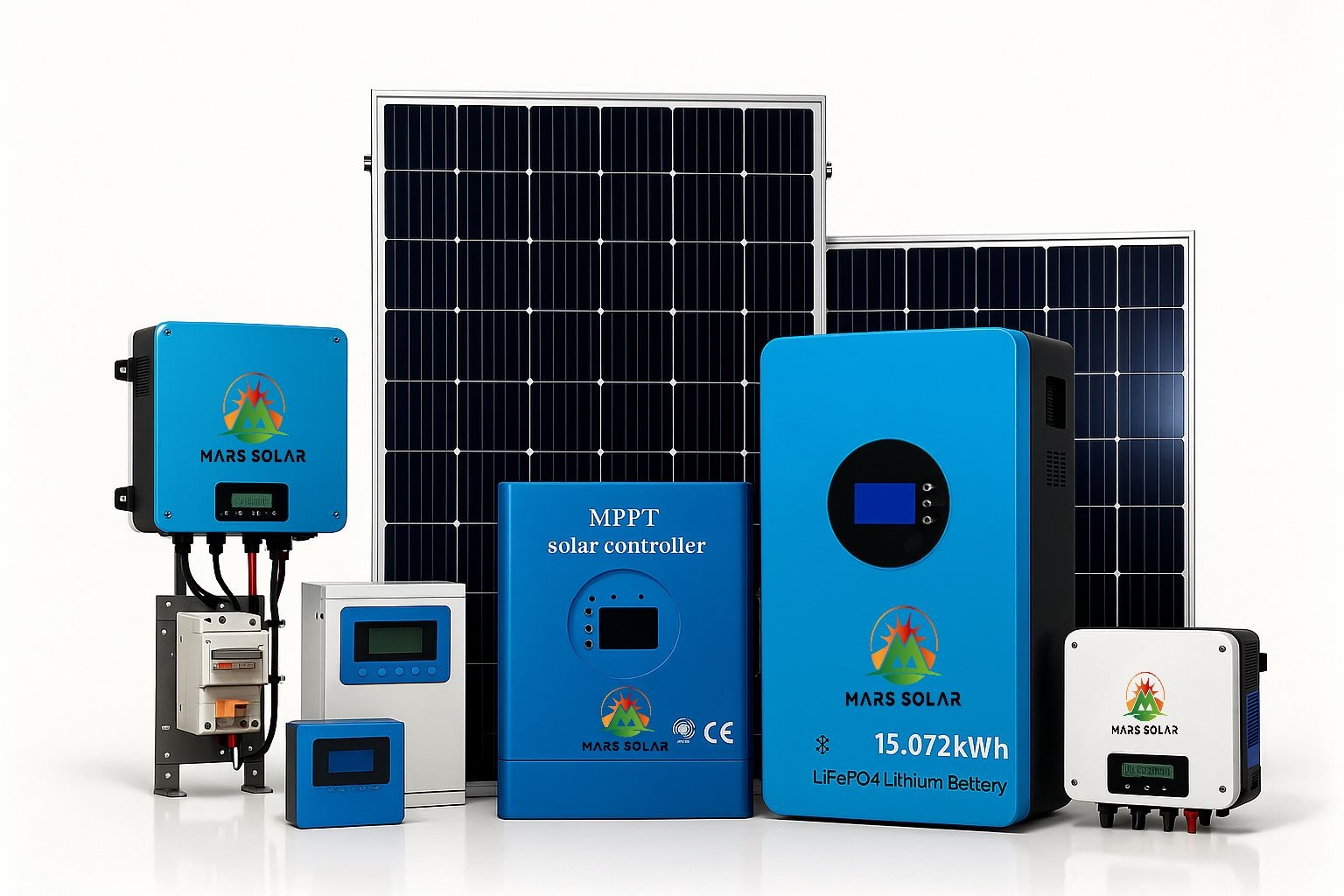
- Typical Parameters: For example, the Mars H10K inverter has a rated power of 10kW, supports 4 MPPT channels, has a voltage range of 150-1000V, and is compatible with more than 90% of new and old panel models.
(3) Smart Monitoring Platform Upgrade
- Functional Modules: Real-time power monitoring (accuracy ±2%), automatic fault diagnosis (response time < 10s), data integration of new and old equipment (supporting the access of old systems with a service life of more than 10 years).
- Practical Value: The system operation strategy can be adjusted remotely through a mobile APP (e.g., Mars Connect), such as prioritizing energy storage charging or grid feed-in.
6. Return on Investment (ROI) and Energy Efficiency Case: Residential Project in California, USA (Detail-Supplemented Version)
|
Parameter |
Before Expansion (5kW System) |
After Expansion (5kW + 3kW Added) |
Change Analysis |
|
Total System Capacity |
5kW (polycrystalline panels) |
8kW (old polycrystalline + new TOPCon) |
60% capacity increase |
|
Inverter Type |
Traditional single-MPPT inverter |
Hybrid multi-MPPT inverter |
Supports dual-panel string access |
|
Energy Storage Configuration |
None |
15kWh lithium iron phosphate battery |
Enables 3-4 hours of off-grid power supply at night |
|
Annual Power Generation |
7,200 kWh |
11,520 kWh |
60% increase (including energy storage charge-discharge optimization) |
|
Self-Consumption Rate |
~35% |
~65% |
Energy storage reduces grid power purchase demand |
|
Annual Electricity Cost Savings |
$864 |
$2,160 |
150% increase (California electricity price: $0.30/kWh) |
|
Initial Expansion Cost |
- |
$3,840 (including equipment + installation) |
Actual cost after California subsidy: $2,688 |
|
Payback Period |
10 years (original system) |
7 years (entire system after expansion) |
3-year reduction |
Key Conclusion: Currently, the price of PV panels has dropped to 0.08-0.10 USD/Wdc. Combined with regional subsidies, the average payback period of expansion projects has been reduced to 3-5 years, which is better than that of new systems (5-8 years).
7. Best Practices for Expansion Implementation (Step-Detailed Version)
Step 1: Comprehensive System Audit (Core Inspection Items)
- Panel Parameters: Peak power (Pmax), open-circuit voltage (Voc), short-circuit current (Isc), degradation rate (actual degradation of old panels needs to be measured; for example, the degradation rate of polycrystalline panels with a service life of more than 5 years is approximately 12%-15%).
- Inverter Limitations: Rated input power, number of MPPT channels, voltage range (to avoid the voltage of newly added panel strings exceeding the inverter upper limit).
- Installation Environment: Roof load-bearing capacity (newly added panels require ≥20kg/㎡ load-bearing capacity), sunshine duration (shading analysis to avoid newly added panels shading old ones).
Step 2: Future Demand Forecasting
- Short-Term (1-3 Years): Whether to add EV charging piles (requiring an additional 7-11kW capacity) and household electricity consumption growth (e.g., adding air conditioners).
- Long-Term (5-10 Years): Whether to consider energy storage expansion (e.g., increasing from 5kWh to 15kWh) and changes in grid policies (e.g., adjustments to feed-in tariffs).
Steps 3-6: Component Selection → Inverter Selection → Approval → Professional Cooperation
- Component Selection Principle: The voltage difference between new and old panels should be ≤15%, and the power difference should be ≤30% (e.g., old 490W panels can be matched with new 590W panels).
- Key Approval Materials: System audit report, component/inverter certification certificates (e.g., TÜV, UL), local grid connection application forms.
- Partner Requirements: Select installation teams certified by NABCEP (North America) or TÜV (Europe) to ensure warranty coverage (5-25 years for equipment).
8. Mars PV Expansion Professional Services (Case-Supplemented Version)
- Customized Evaluation: Provides free on-site testing (including panel degradation testing and inverter load testing) and issues a compatibility report within 3 working days.
- Modular Equipment: Highly compatible product series (e.g., 590W/620W/630W/650/700W N-type panels, 3KW~800KW MPPT inverters, 3kWh-80MWH energy storage batteries) supporting "on-demand combination".
- Successful Cases: In 2024, it completed expansion for 400 residential households in Colombia, with an average system efficiency increase of 58% and a 2.8-year reduction in users' payback period; it expanded 400kW for a factory in the Philippines, realizing integrated PV + energy storage and increasing peak-valley arbitrage income by 35%.
- Global Support: After-sales network covering more than 100 countries, providing 7×24-hour remote fault diagnosis, with a maximum equipment warranty of 25 years.
9. Conclusions and Action Recommendations
PV system expansion has become the optimal solution to cope with growing energy demand and reduce costs. Compatibility barriers have been completely solved through technologies such as string optimizers and multi-MPPT inverters, and the ROI of expansion projects is better than that of new systems.
Action Recommendations:
- If your system has been in operation for more than 3 years and the annual power generation satisfaction rate is <70%, it is recommended to conduct a free compatibility evaluation immediately (you can contact the Mars official website).
- The subsidy policies of many countries will enter a countdown in 2026. It is recommended to start expansion planning before the end of 2025 to lock in subsidy dividends.
- Prioritize the integrated expansion solution of "panels + inverters + energy storage" to avoid secondary transformation in the future.
-
 100kVA 100kW Off-Grid Solar Power Plant | Mars Solar 2026 Specification & Price100kVA 100kW Off-Grid Solar Power Plant | Mars Solar 2026 Specification & Price Mars Solar’s 100kVA 100kW off-grid solar power plant is a high-efficiency, scalable renewable energy solution engineered for commercial and industrial application
Do you like ?0
Read more -
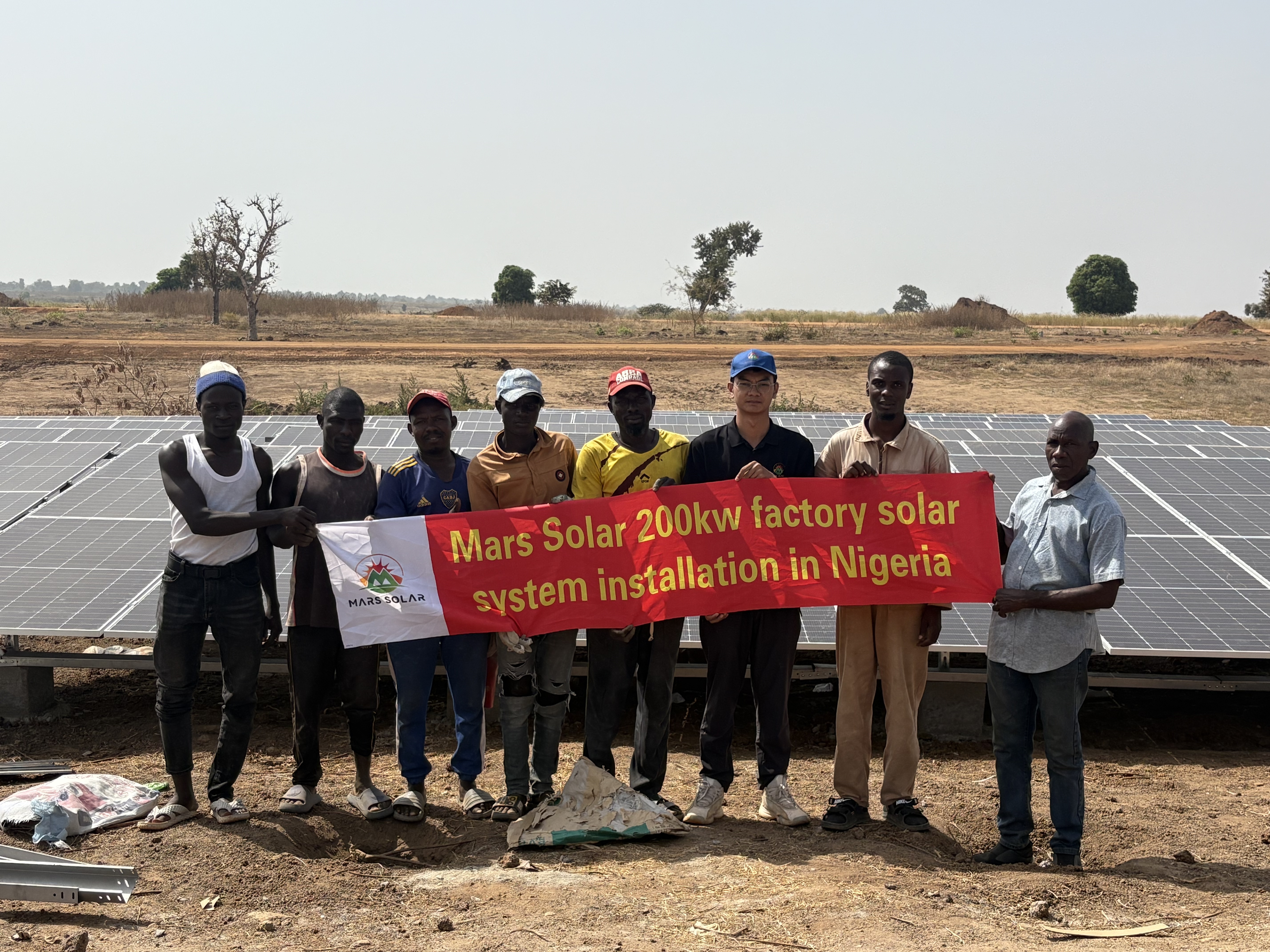 Case Study: 200kW Solar Power System Project for a Rice Mill in a Remote Area ofProject Overview This is a rice mill located in a remote area of Abuja, Nigeria. The local municipal power supply is unstable, and electricity tariffs have increased multiple times this year. Due to the unreliable grid power, the customer can only oper
Do you like ?0
Read more -
 Solar PV System Expansion: Compatibility, Efficiency & Implementation Guide1. Background and Necessity Early-installed PV systems generally fail to meet the growing energy demands of modern households and enterprises. Compared with replacing the entire system, expansion is a more economical option—but the core question
Do you like ?0
Read more -
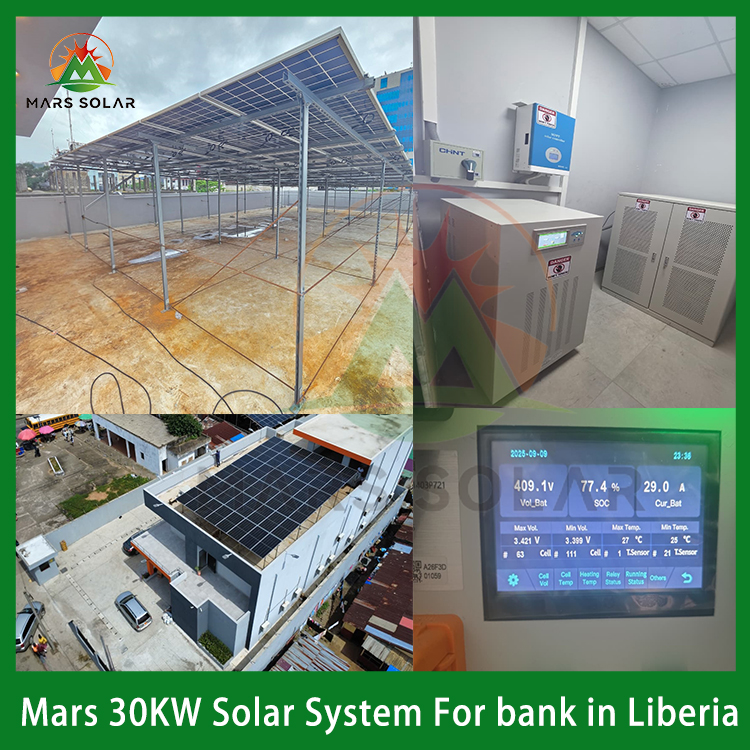 Customized Off-Grid Solar System for a Liberian Bank: Achieving Power IndependenWhen Banks Face the Challenge of "Grid Power Outages and Voltage Fluctuations": A Real-World Solution from Liberia In scenarios where the power grid is unstable and manual intervention is difficult, how to ensure the 24/7 stable operation
Do you like ?0
Read more -
 2MW Solar Panel System For Factory2MW mars solar grid-tied solar panel system for factory have designed, produced, and installed in a factory.How does Mars Solar build such a solar panel system for factory? 1. Data collection Before designing the plan, the factory owner vi
Do you like ?0
Read more -
 100KW Solar For Hotels And Resorts In NigeriaIn December 2024, the Mars Solar 100KW Nigeria solar for hotels and resorts project was successfully completed. In May 2024, the customer contacted Mars solar and had a series of communications on the solar for hotels and resorts project. The d
Do you like ?0
Read more